


The Tramvia Blau workshop opens its doors to celebrate its 125th anniversary
A unique opportunity to discover the inner workings of Barcelona’s most beloved historic mode of transport.

When: 14.11.2026 to 15.11.2026

Where: Plaça Central, 2-4 (Sarrià - Sant Gervasi)

Access: Bus
The Tramvia Blau is celebrating 125 years of history and, at TMB, we want to mark this milestone with a series of activities open to the public.
On 7 and 8 November, people in Barcelona had the opportunity to hop aboard one of its trams and celebrate this anniversary on Avinguda del Tibidabo.
Now it’s time to discover what goes on behind the scenes. On 14 and 15 November, we’re opening the doors of the tram depots so you can visit the workshop and explore the history of this century-old mode of transport, which has become one of Barcelona’s most cherished icons.
During the visit, you’ll have the chance to get up close to three of its trams: the Open-sided Summer Tram, Tramvia Blau No. 2 and Tramvia Blau No. 10.
- 14 and 15 November 2026
- 10 am to 2 pm
You can get there by taking bus routes 126, 196 or V13.
Coming soon, you’ll also be able to visit a commemorative exhibition at Espai Mercè Sala
Tramvia Jardinera (open sided summer tram)
The only open-sided summer tram preserved from Barcelona’s former tram network. Tram 129 belongs to a series of nine electric vehicles built in 1906 to reinforce summer services on the waterfront lines. These open-sided trams, fitted with a roof, allowed passengers to travel in the open air and were very popular between 1873 and 1966.
After being withdrawn from service in 1963, the vehicle was restored in 1986 using the chassis of a Tramvia Blau car, recovering its original red colour. In 2021, it was declared a Cultural Asset of National Interest (BCIN) in recognition of its historical and heritage value.
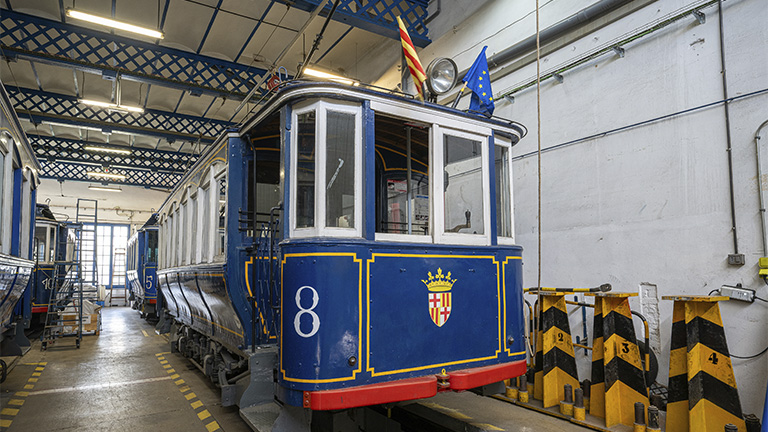
Tramvia Blau No. 2
The only surviving tram from the first series of four vehicles that inaugurated the Tramvia Blau. Built with a Scots pine wooden body and an American Brill chassis, it was designed to tackle the steep gradients of Avinguda del Tibidabo and connect the city with the funicular railway.
Tram 2 was withdrawn from service in 1950 and, after spending decades in the depots, TMB undertook its restoration. It returned to service on 17 December 1983. In 2021, it was declared a Cultural Asset of National Interest (BCIN) in recognition of its historical and heritage value.
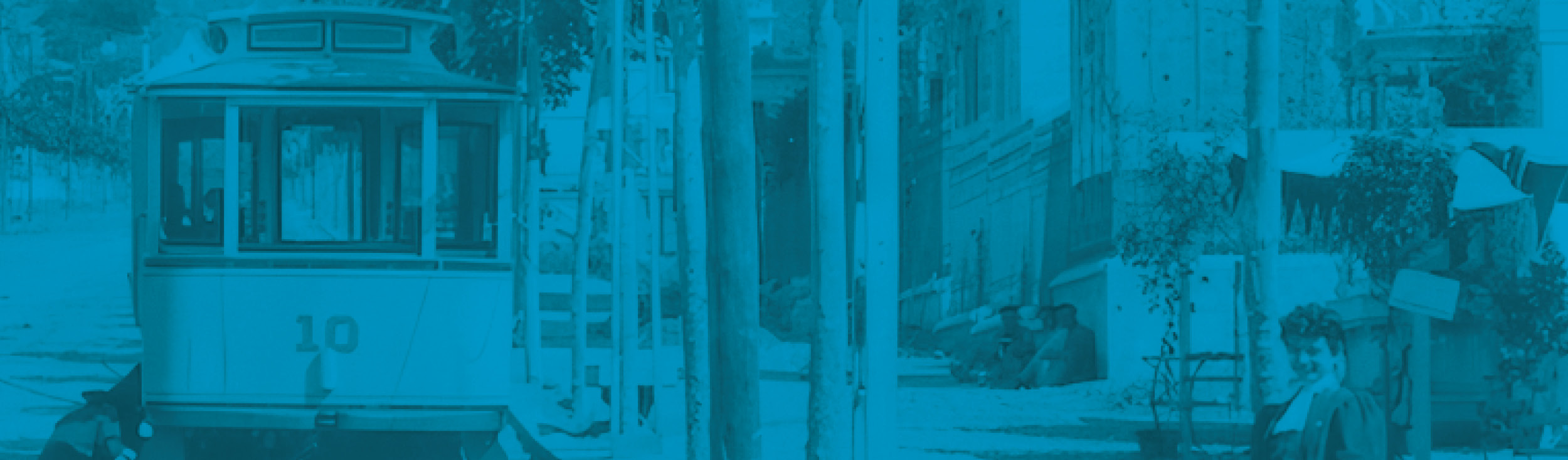
Tramvia Blau No. 10
One of the six trams introduced in 1905 to extend the Tramvia Blau line to Vallvidrera. These vehicles had greater power and passenger capacity than the original trams and were equipped with an electromagnetic brake to improve safety on steep sections.
Following the closure of the Vallvidrera line, they were incorporated into the Tibidabo service. Tram 10 retains much of its original mechanical configuration and is an outstanding example of early 20th-century railway technology. In 2021, it was declared a Cultural Asset of National Interest (BCIN) in recognition of its historical and heritage value.


